

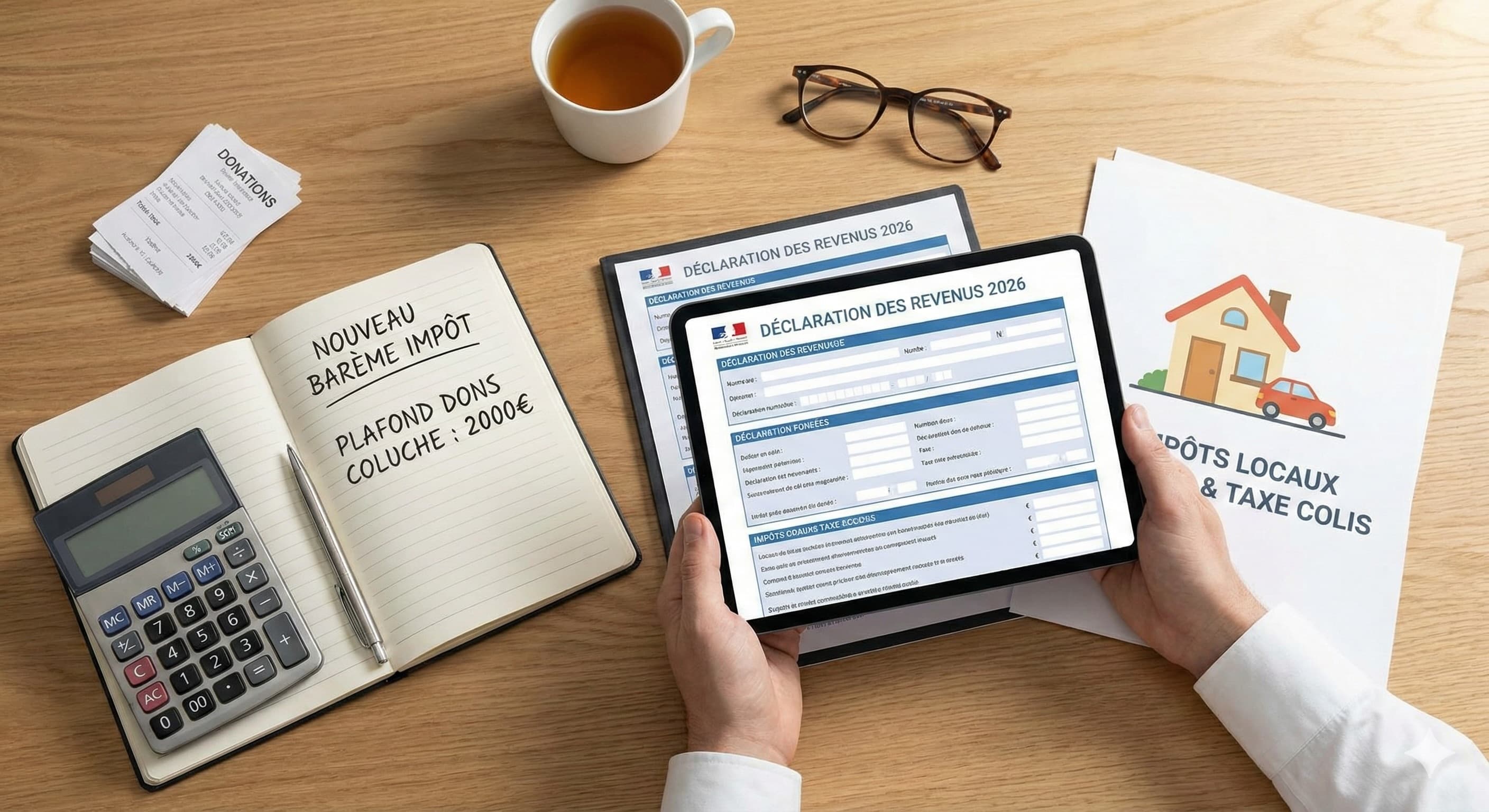
1. Income tax scale revaluation
Good news for taxpayers: the income tax scale is revalued by+0.9%to reflect inflation. The aim is to neutralise the effect of rising prices on households' tax burden — in other words, to avoid paying more tax simply because your income has kept pace with inflation.
The 2026 scale bands are as follows:
- Up to€11,600taxable income per share, the rate is 0%.
- Between€11,601and€29,579, it is 11%.
- Between€29,580and€84,577, it rises to 30%.
- Between€84,578and€181,917, it reaches 41%.
- And above€181,917, the marginal rate is 45%.
In short:If your income has simply followed inflation, you should not pay more tax than last year.
2. Renewal of the differential contribution on high incomes (CDHR)
Introduced in 2025, thedifferential contribution on high incomes (CDHR)is renewed by the 2026 finance act. Its aim: to guarantee aminimum tax rate of 20%on the income of the wealthiest households, until the public deficit falls below 3% of GDP.
It applies to households whose reference tax income for 2025 income exceeds€250,000for a single person or€500,000for a couple.
Please note:If you are below these thresholds, you are not affected by this contribution.
3. Creation of a tax on personal holding companies
The 2026 finance act introduces anew tax on personal holding companies, applicable to financial years ending from31 December 2026. Its scope is narrower than initially envisaged.
It targets only the market value of certain"luxury" assets not linked to a business activityheld by these structures: yachts, collector vehicles, racehorses, jewellery. Excluded from the tax base are cash, financial securities, active holdings and works of art.
The tax rate is20%, and it will apply to holding companies controlled by individuals withassets of at least €5 million.
In practice:This tax targets a very specific wealth profile. It does not affect individuals who hold companies in the context of normal economic activity.
4. Creation of a small-parcel tax
From1 March 2026, a new€2 per item taxapplies to smallimportedparcels. It aims to rebalance competition between foreign e-commerce platforms — particularly Asian ones — and European retailers.
It covers parcels worth less than€150, fromnon-EU third countries.
What this means in practice:If you regularly order from platforms such as Temu or Shein, purchases under €150 will be increased by €2 per item from 1 March 2026.
5. Doubling of the "Coluche" tax relief ceiling
Do you make donations to charities helping people in difficulty? The 2026 finance act doubles the ceiling for the so-called"Coluche"tax relief.
The ceiling rises from€1,000to€2,000 per year, with the relief rate maintained at75%. A donation of €2,000 can therefore give you up to€1,500 in tax relief.
This measure applies to donations made from late 2025, for the 2026 income tax return.
Reminder:The "Coluche" relief applies to donations to non-profit organisations of general interest helping people in difficulty (humanitarian charities, food banks, etc.).
6. Driving licence funding via CPF: restricted access
An important change for those who planned to use theirPersonal Training Account (CPF)to fund their driving licence.
Funding for preparation for light vehicle driving tests (categories A1, A2, B1 and B) via the CPF is nowlimited to jobseekersor employees benefiting fromsupplementary funding from a third party(employer, skills operator, etc.).
In addition,help for apprentices to fund their driving licence is abolished.
In short:If you are an employee in work and wish to take your driving licence, you can no longer use your CPF alone to fund it. Co-funding will now be required.
Key takeaways
The 2026 finance act brings several changes directly affecting individuals:
- Theincome tax scaleis revalued by 0.9% to offset inflation.
- TheCDHR(minimum 20% tax rate) is renewed for high earners exceeding €250,000 (single) or €500,000 (couple).
- A20% tax on luxury assetsheld via personal holding companies is created for estates of at least €5 million.
- A€2 per item taxapplies to small non-EU parcels under €150, from 1 March 2026.
- The"Coluche" donation ceilingis doubled to €2,000 at 75% tax relief.
- TheCPF funding for the driving licenceis now reserved for jobseekers or employees with co-funding.
To optimise your personal tax position in light of these changes, please book an appointment with our firm.